THE MESTIZAJE LIE
Biological Anthropology — Facial Composite Analysis
★ 130 subjects • 3 populations • 12 phenotype references ★
I. THE THESIS
Mexico's national ideology of mestizaje — the claim that racial mixing has produced a single, unified Mexican people — is a lie. It functions as ideological cover for a pigmentocracy: a racial caste system in which lighter-skinned, European-phenotype individuals dominate political and economic power, while darker-skinned, indigenous-phenotype individuals are systematically excluded.
This study tests that claim computationally. We collect public photographs of three populations:
- Iberian politicians (Spain & Portugal) — the colonial source population
- Mexican governors & presidents — the political elite
- Mexican cartel leaders — individuals excluded from legitimate power structures
We generate facial composites (averaged faces) for each group and compare them against standardized anthropological phenotype references using multi-metric similarity analysis.
"In Mexico, the lighter your skin, the more likely you are to hold a professional position, earn a higher income, and attain higher education. The darker your skin, the more likely you are to live in poverty."
— PERLA Project (Telles & Steele, 2012)
II. METHODOLOGY
Sample
| Group | Total | Male (used) | Source |
|---|---|---|---|
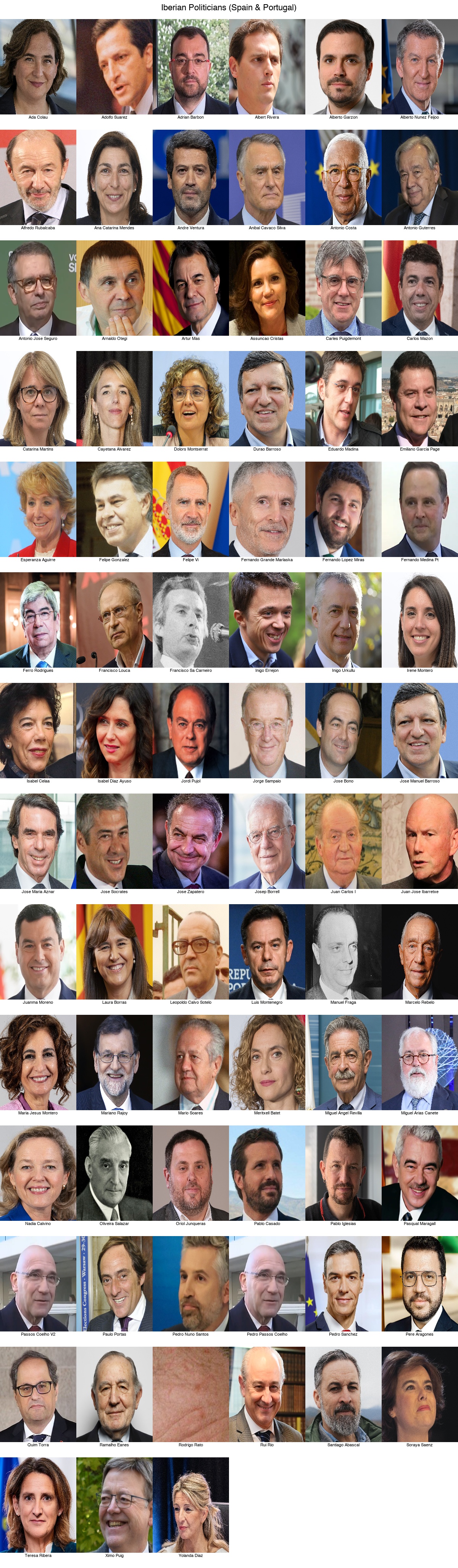
| Iberian Politicians | 81 | 64 | Wikipedia/Wikimedia Commons |
| Mexican Governors/Presidents | 98 | 83 | Wikipedia/Wikimedia Commons |
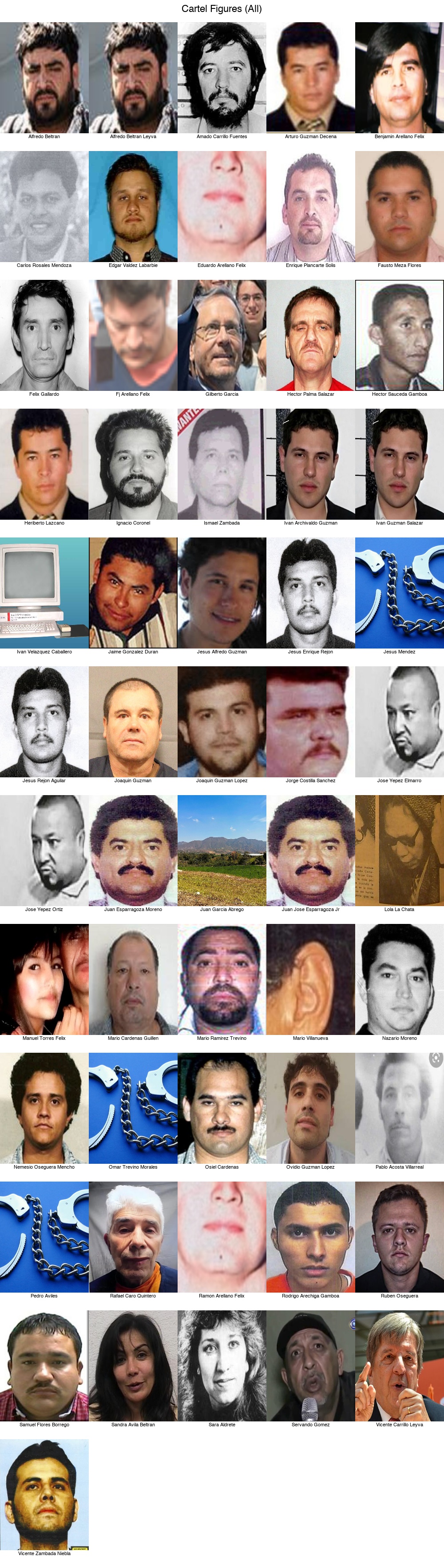
| Cartel Leaders | 56 | 53 | Wikipedia/Wikimedia Commons |
All photographs are publicly available. Only male subjects are used for composite generation to ensure comparability against male phenotype references. Female subjects are included in collages but excluded from composites.
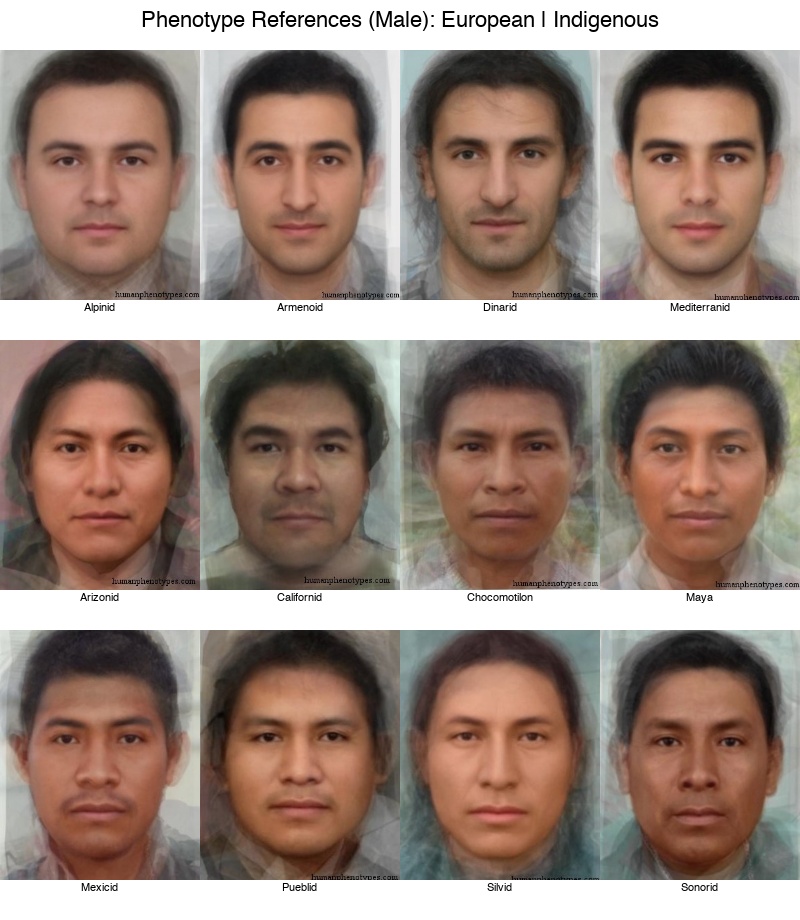
Phenotype References
12 standardized male phenotype composites from humanphenotypes.net, split into two categories:
| European Types | Indigenous American Types | ||
|---|---|---|---|
| Alpinid | Central European | Californid | NW Mexico/Baja California |
| Armenoid | Near Eastern/Caucasus | Arizonid | SW United States/N Mexico |
| Dinarid | Southeastern European | Mexicid | Central Mexico |
| Mediterranid | Southern European | Pueblid | Pueblo peoples |
| Maya | Yucatan/Guatemala | ||
| Sonorid | Sonoran Desert | ||
| Silvid | South American | ||
| Chocomotilon | Colombian/Venezuelan | ||
Processing Pipeline
- Face Detection: OpenCV Haar cascade classifier (multi-scale, fallback to center crop)
- Normalization: All faces resized to 200×250px. CLAHE histogram equalization applied to LAB lightness channel to neutralize lighting bias
- Compositing: Pixel-wise averaging across all faces in each group (float64 precision)
- Skin Masking: YCrCb color space thresholding isolates skin pixels for color analysis
- Similarity Scoring: Multi-metric comparison against each phenotype reference:
Combined = 0.45 × ColorHist + 0.30 × EdgeSSIM + 0.25 × SSIM
• ColorHist: LAB color histogram correlation on skin-masked regions (A and B channels weighted 2×)
• EdgeSSIM: SSIM on Canny edge maps (captures facial structure independent of lighting)
• SSIM: Structural Similarity Index on normalized grayscale
III. THE PHENOTYPE GRADIENT
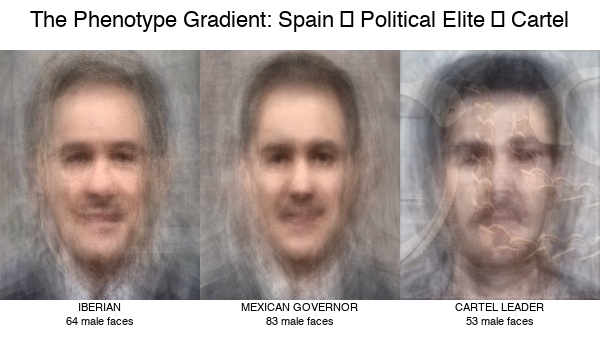
The central finding. Three composites, left to right: colonial source → political elite → cartel leaders. The gradient is visible to the naked eye.
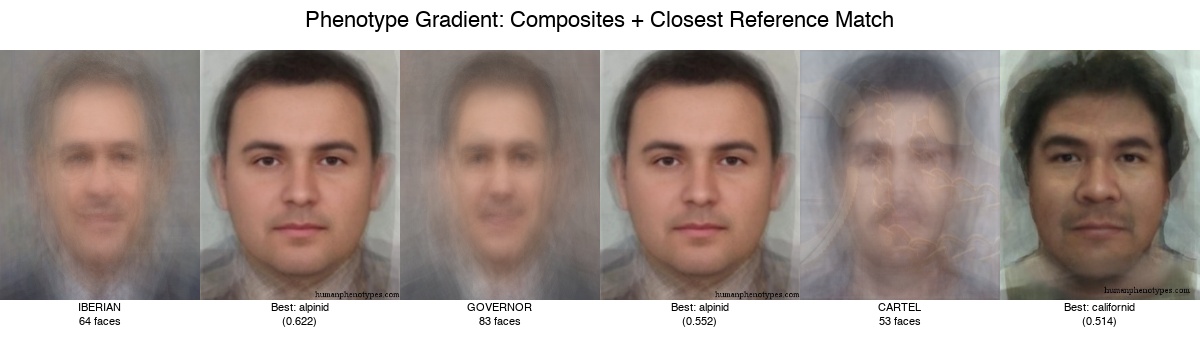
Top Phenotype Matches
| Group | #1 Match | Score | Type |
|---|---|---|---|
| Iberian | Alpinid | 0.622 | European |
| Mexican Governor | Alpinid | 0.552 | European |
| Cartel Leader | Californid | 0.514 | Indigenous American |
The Iberian and Governor composites both match European phenotypes (Alpinid). The Cartel composite matches an Indigenous American phenotype (Californid — the type native to northwestern Mexico, where most major cartels are geographically based).
European vs. Indigenous Affinity
| Group | Avg European Similarity | Avg Indigenous Similarity | Ratio (I/E) |
|---|---|---|---|
| Iberian | 0.574 | 0.454 | 0.792 |
| Mexican Governor | 0.501 | 0.419 | 0.837 |
| Cartel Leader | 0.438 | 0.381 | 0.870 |
The Iberian composite is the most European-leaning (lowest ratio). The Governor composite sits between Iberian and Cartel. The Cartel composite is the least European-leaning. This is the phenotype gradient: colonial source → political elite → excluded population.
IV. THE FOLKWAYS ANALYSIS
Why Folkways Are the Highest Upstream
In 1989, David Hackett Fischer published Albion's Seed and changed how we understand America. He showed that four distinct British folkways — Puritan, Cavalier, Quaker, and Borderer — transplanted themselves into colonial America and never left. Not for four hundred years. Not through a revolution, a civil war, industrialization, or mass immigration. The folkway persists because it is deeper than ideology, deeper than economics, deeper than language. It is the inherited pattern of how a people organize kinship, authority, honor, death, and land. It is the deepest unit of cultural analysis. Everything else — politics, economics, even religion — is downstream.
This study applies Fischer's framework to Mexico. The argument is simple:
- Mestizaje — the claim that racial mixing produced a single, unified Mexican people — is a civic national identity myth, not a demographic reality.
- Mexico is still deeply racially stratified. The phenotype gradient above proves it computationally: Spanish faces govern, indigenous faces are excluded.
- Mexican cartels are not, at their most fundamental level, criminal organizations. They are ethnic organizations seeking sovereignty and autonomy. The drugs are an outcome, not the cause.
- The evidence is in the map: cartel territorial boundaries track pre-Columbian indigenous folkway boundaries with startling precision.
- If this were Europa Universalis, these would be tagged as "Mexica Nationalists," "Purepecha Separatists," "Cahita Autonomists." We would see them instantly for what they are. The only reason we don't is that the Castilian folkway won the naming rights.
This is part of a larger thesis on the primacy of folkways in human organization, drawing on Fischer's work in the Anglo-American context and extending it to the Ibero-American one. The argument is that folkways are the most powerful and persistent force in human political organization — more durable than states, more explanatory than economics, more honest than ideology. If you want to understand why Mexico looks the way it does, you don't start with drug policy or NAFTA or corruption indices. You start with the folkways.
The Castilian Folkway
The Spanish who conquered and settled Mexico were not generic "Spaniards." They were overwhelmingly Castilians — from the central meseta, the kingdom that drove the Reconquista, the culture that produced the hidalgo (hijo de algo, "son of something"). The Castilian folkway is characterized by:
- Patrilineal honor culture — family name as the supreme social currency. Honor is inherited, not earned. Dishonor to one is dishonor to the bloodline.
- Limpieza de sangre — "purity of blood." Originally a religious test (no Jewish or Muslim ancestry), it became the template for racial caste in the colonies. The same mechanism that sorted cristianos viejos from conversos in Spain sorted criollos from mestizos from indios in New Spain. The sistema de castas is limpieza de sangre with a paint chart.
- Latifundia — concentrated land ownership by a small elite. The encomienda and hacienda systems were direct transplants of Castilian land patterns. The PRI's ejido reforms nominally ended this; the distribution of actual economic power did not.
- Centralized authority — power radiates from the capital. Mexico City replaced Tenochtitlan replaced Madrid. The viceroy replaced the king. The president replaced the viceroy. The chair changed; the architecture of power did not.
- Baroque Catholicism — not the austere Catholicism of the Basques or the mystical Catholicism of Galicia, but the performative, hierarchical, state-fused Catholicism of Castile. The Virgin of Guadalupe is the masterpiece of this folkway: an indigenous apparition absorbed into the Castilian religious framework and handed back as proof of unity.
The Alpinid Tell: The Castilian Folkway Has a Face
Now look at the phenotype data. The Iberian composite matches Alpinid, not Mediterranid. This demands explanation.
The Alpinid type is Central European. Southern Spain — Andalusia, the coastal regions — is Mediterranid. But the Spanish political class is not from southern Spain. It is from Castile, the Basque Country, Galicia, Catalonia — the northern and central regions where centuries of Visigothic, Frankish, Burgundian, and Habsburg dynastic marriage deposited a northern European aristocratic admixture into the ruling families. The Spanish political class is phenotypically more "Alpine" than "Mediterranean" because it descends from the same Central European aristocratic stock that ruled half of Europe.
The Mexican governor composite also matches Alpinid. Five centuries. An ocean. A revolution. An independence war. A second revolution. And the criollo elite still carries the phenotypic signature of Castilian aristocratic blood, maintained through endogamy so thorough that the face of Mexican power in 2026 still looks like the face of Spanish power in 2026.
The criollos didn't just inherit Castilian culture. They inherited Castilian blood, and they kept it. The mestizaje myth says everyone mixed. The faces say the people at the top didn't.
The Indigenous Folkways
What mestizaje erases is that pre-Columbian Mexico was not one culture. It was dozens of distinct folkways, as different from each other as Fischer's Puritans were from his Borderers:
- The Nahua/Aztec folkway (Central Mexico) — imperial, tributary, militaristic, urban. The altepetl (city-state) as the unit of political organization. Elaborate bureaucracy. Flower wars. This is the folkway of the Valley of Mexico, Puebla, Tlaxcala.
- The Maya folkway (Yucatan, Chiapas, Guatemala) — city-state federations, astronomical-calendrical priesthood, long-distance trade networks. Decentralized. The Maya never had a single empire; they had dozens of competing polities. This pattern persists: the EZLN in Chiapas is a Maya folkway expression.
- The Northwestern folkway (Sinaloa, Sonora, Durango, Chihuahua) — semi-nomadic, clan-based, desert-adapted. The Yaqui, Mayo, Tarahumara, Tepehuan. Fierce resistance to both Aztec and Spanish expansion. The Yaqui Wars lasted until 1929 — they were still fighting the Mexican state within living memory. This is cartel country.
- The Oaxacan folkway (Zapotec, Mixtec) — mountaintop kingdoms, artisan traditions, fierce local autonomy. Oaxaca today has the highest indigenous population percentage of any Mexican state and the strongest tradition of communal self-governance (usos y costumbres).
- The Michoacan folkway (Purepecha/Tarascan) — the only Mesoamerican state that successfully resisted Aztec conquest. Independent metallurgy tradition. A people who never submitted to the dominant indigenous empire and then never submitted to the Spanish one either. Also cartel country (La Familia Michoacana, Knights Templar Cartel).
These are not historical curiosities. These are living folkways. They did not dissolve into mestizaje. They persisted — in land use patterns, in kinship structures, in the way communities organize authority, in the territories people fight and die for.
The Cartel Map Is the Pre-Columbian Map
This is the core claim. Cartel territorial boundaries are not arbitrary lines drawn by criminals. They track pre-Columbian cultural and linguistic boundaries:
| Cartel Territory | Pre-Columbian Region | Indigenous Folkway |
|---|---|---|
| Sinaloa Cartel | Aztatlan / Cahita lands | Northwestern (Mayo, Yaqui, Cahita) |
| CJNG (Jalisco) | Western Mesoamerican frontier | Caxcan / Coca / Tecuexe |
| La Familia / Knights Templar | Purepecha Empire (Irechequa Tzintzuntzan) | Purepecha (Tarascan) |
| Los Zetas / Gulf (Tamaulipas) | Huasteca / Chichimec frontier | Huastec / semi-nomadic north |
| Tijuana Cartel | Kumeyaay / Pai Pai lands | Californid (Yuman peoples) |
| Juarez Cartel | Suma / Manso / Jumano lands | Chihuahuan Desert peoples |
The Sinaloa Cartel operates in exactly the territory of the Cahita-speaking peoples. La Familia Michoacana rose in the exact territory of the Purepecha Empire — the one Mesoamerican state that never submitted to the Aztecs. The Zetas controlled the Huasteca, the ancient frontier between Mesoamerica and the nomadic north. These are not coincidences. These are folkways.
If you opened Europa Universalis IV and placed the cartel map over the 1444 start date, the borders would align. The Sinaloa Cartel is the Cahita people. La Familia is the Purepecha. The CJNG is the Caxcan confederacy. They have goofy names and they traffic fentanyl, but the underlying political geography is pre-Columbian. It always was.
It's Not About Drugs
The conventional framing of Mexican cartels — as criminal enterprises motivated by profit from the drug trade — is not wrong, but it is shallow. It is like saying the American Revolution was about tea taxes. The drugs are the occasion, not the cause.
At their most pure expression, cartels are ethnic organizations that want sovereignty and autonomy. They are the political expression of indigenous folkways that were never absorbed into the Castilian state — that were pushed to the margins, excluded from legitimate power, and left with no institutional path to self-governance within the Mexican republic.
- Nazario Moreno (La Familia Michoacana) built an explicitly religious-communitarian organization with its own scripture, social services, and moral code. He didn't build a corporation. He built a community — the exact pattern of indigenous resistance to colonial authority since the 16th century. He built a church in Purepecha country, for Purepecha people, outside the Castilian state.
- The Knights Templar Cartel structured themselves as a cofradía (brotherhood) — the same organizational form that indigenous communities used to maintain autonomy under Spanish colonial rule. The cofradía is one of the oldest surviving indigenous institutions in Mesoamerica.
- Autodefensa movements in Michoacan and Guerrero — indigenous communities arming themselves against cartels — are operating from the same folkway as the communities the cartels emerge from. The autodefensas and the cartels are competing expressions of the same indigenous political tradition: local, communitarian, clan-based authority outside the Castilian state. They fight each other because they are siblings, not strangers.
- Cartel leaders are dismissed as narcos by the Castilian-phenotype political class. But from a folkways perspective, they are regional strongmen operating indigenous patronage networks in territories that predate the Mexican state by millennia. The cacique is not a colonial invention. It is a pre-Columbian institution. The colony co-opted it. The republic pretended it didn't exist. The cartels are what happens when you pretend a folkway doesn't exist for five hundred years.
The Mexican state's refusal to recognize cartels as anything other than criminal organizations is itself a continuation of the colonial project. To acknowledge the indigenous folkway roots of cartel territorial organization would be to acknowledge that Mexico is not one nation but many — that mestizaje failed — that the Castilian folkway conquered the government but never conquered the land. The war on drugs is a culture war. It always was.
The Phenotype Gradient Is the Folkway Gradient
Return to the faces. The Iberian composite: Alpinid. The Governor composite: Alpinid. The Cartel composite: Californid.
The Alpinid signal is the Castilian aristocratic bloodline — Visigothic and Habsburg, maintained across five centuries and an ocean through endogamy. The Californid signal is the indigenous Northwestern peoples — the Cahita, Yaqui, Mayo. The people of Sinaloa.
The gradient is not random. It is the fossilized caste system of New Spain, still visible in the faces of the people who hold power and the people who are excluded from it. The faces tell the same story as the folkways, the land tenure patterns, the CONAPRED discrimination surveys, the cartel territory map, and the pre-Columbian linguistic map. It is all one story.
A Castilian colonial elite that never left. A patchwork of indigenous nations that never surrendered. A civic myth called mestizaje stretched over the gap like a tarp over a crater. And underneath it, the same war that started in 1519, fought by the same peoples, over the same land, with different names.
Mestizaje is the name the winners gave to their victory. The cartels are what the losers built when they stopped believing in it.
V. THE SURNAME EVIDENCE
If faces reveal what the colonial system tried to hide, surnames reveal what the colonial system imposed. Both groups carry overwhelmingly Spanish surnames — but the patterns diverge dramatically.
| Metric | Cartel Leaders | Governors/Presidents |
|---|---|---|
| Spanish/Castilian surnames | 100.0% | 81.0% |
| Non-Spanish European surnames | 0.0% | 18.3% |
| Indigenous surnames | 0.0% | 0.7% (1 person) |
| People with non-Spanish Euro surnames | 0 / 53 | 28 / 97 (28.9%) |
The Governor Surname Tapestry
Nearly one in three governors/presidents carries a non-Spanish European surname, revealing the cosmopolitan elite immigration streams that built Mexico's ruling class:
| Origin | Names |
|---|---|
| French | Ebrard, Casaubón, Massieu, Servién |
| English/Irish | Fox, Creel, Bartlett, Yarrington |
| Lebanese | Kuri, Fayad, Harfuch, Nahle |
| Ashkenazi Jewish | Sheinbaum |
| German/Dutch | Müller, Coppel |
| Basque aristocratic | de Gortari, de Ochoa |
| Castilian aristocratic | Ponce de León, de la Madrid, de Lamadrid |
| Catalan | Vila, Rovirosa, Sansores |
| Scandinavian | Borge |
| Chinese | Chong |
Among cartel leaders: zero. Every single surname — Guzmán, Zambada, Carrillo, Arellano, Cárdenas, Oseguera, Beltrán — is a Spanish colonial patronymic. No French. No English. No Lebanese. No German. No cosmopolitan elite immigration. The ruling class absorbed immigrants from every corner of Europe and the Levant. The cartel world did not.
The Colonial Naming Paradox
The absence of indigenous surnames among cartel leaders does not mean they are Spanish. It means the colonial sistema de castas worked exactly as intended: indigenous peoples were baptized with Spanish names, erasing their linguistic identity. The only indigenous surname in the entire dataset is May (Maya origin) — belonging to a governor, not a cartel leader.
Three Nahuatl first names appear among politicians — Cuauhtémoc Blanco, Cuitláhuac García, Xóchitl Gálvez — but these are modern nationalist gestures, not inherited indigenous identity. The surnames remain Spanish.
This is the paradox: the names cannot distinguish indigenous from Spanish because the colonial system made sure of it. The faces tell the truth that the names cannot.
VI. FULL SIMILARITY DATA
Iberian Composite vs. All Phenotypes
| Phenotype | Combined | Color | Edge | SSIM |
|---|---|---|---|---|
| Alpinid | 0.6223 | 0.8586 | 0.5215 | 0.3179 |
| Californid | 0.5793 | 0.7736 | 0.5096 | 0.3132 |
| Mediterranid | 0.5747 | 0.7263 | 0.5469 | 0.3351 |
| Armenoid | 0.5531 | 0.6925 | 0.5108 | 0.3530 |
| Dinarid | 0.5440 | 0.8010 | 0.3703 | 0.2898 |
| Arizonid | 0.4973 | 0.6171 | 0.4593 | 0.3271 |
| Chocomotilon | 0.4967 | 0.6965 | 0.3688 | 0.2906 |
| Pueblid | 0.4820 | 0.5871 | 0.4851 | 0.2892 |
| Maya | 0.4299 | 0.5442 | 0.3822 | 0.2814 |
| Mexicid | 0.4232 | 0.4628 | 0.4707 | 0.2950 |
| Silvid | 0.3903 | 0.3690 | 0.4945 | 0.3035 |
| Sonorid | 0.3335 | 0.3257 | 0.3698 | 0.3039 |
Governor Composite vs. All Phenotypes
| Phenotype | Combined | Color | Edge | SSIM |
|---|---|---|---|---|
| Alpinid | 0.5521 | 0.6969 | 0.5289 | 0.3194 |
| Californid | 0.5268 | 0.6489 | 0.5236 | 0.3110 |
| Mediterranid | 0.4981 | 0.5694 | 0.5337 | 0.3269 |
| Arizonid | 0.4878 | 0.6013 | 0.4588 | 0.3181 |
| Armenoid | 0.4825 | 0.5427 | 0.5135 | 0.3367 |
| Dinarid | 0.4697 | 0.6382 | 0.3739 | 0.2815 |
| Pueblid | 0.4557 | 0.5256 | 0.4851 | 0.2947 |
| Chocomotilon | 0.4307 | 0.5452 | 0.3738 | 0.2931 |
| Mexicid | 0.3932 | 0.3927 | 0.4783 | 0.2921 |
| Maya | 0.3831 | 0.4350 | 0.3931 | 0.2777 |
| Silvid | 0.3735 | 0.3267 | 0.5019 | 0.3035 |
| Sonorid | 0.3012 | 0.2419 | 0.3867 | 0.3053 |
Cartel Composite vs. All Phenotypes
| Phenotype | Combined | Color | Edge | SSIM |
|---|---|---|---|---|
| Californid | 0.5135 | 0.6392 | 0.4652 | 0.3453 |
| Arizonid | 0.4853 | 0.6316 | 0.3989 | 0.3257 |
| Mediterranid | 0.4581 | 0.5009 | 0.4770 | 0.3585 |
| Alpinid | 0.4558 | 0.4992 | 0.4674 | 0.3639 |
| Dinarid | 0.4188 | 0.5175 | 0.3465 | 0.3276 |
| Armenoid | 0.4197 | 0.4086 | 0.4543 | 0.3981 |
| Pueblid | 0.4035 | 0.4410 | 0.4224 | 0.3133 |
| Silvid | 0.3635 | 0.3360 | 0.4501 | 0.3093 |
| Chocomotilon | 0.3539 | 0.3940 | 0.3246 | 0.3167 |
| Mexicid | 0.3366 | 0.2983 | 0.4120 | 0.3153 |
| Maya | 0.3353 | 0.3523 | 0.3240 | 0.3182 |
| Sonorid | 0.2559 | 0.1711 | 0.3289 | 0.3210 |
VII. SOURCE MATERIAL

VIII. CITATIONS & FURTHER READING
- Fischer, D.H. (1989). Albion's Seed: Four British Folkways in America. New York: Oxford University Press.
- Telles, E. & Steele, L. (2012). "Pigmentocracy in the Americas: How is Educational Attainment Related to Skin Color?" Americas Barometer Insights, LAPOP. PDF
- Moreno Figueroa, M.G. (2010). "Distributed Intensities: Whiteness, Mestizaje and the Logics of Mexican Racism." Ethnicities, 10(3), 387-401.
- Moreno Figueroa, M.G. & Saldivar, E. (2016). "'We Are Not Racists, We Are Mexicans': Privilege, Nationalism, and Post-Race Ideology in Mexico." Critical Sociology, 42(4-5), 515-533.
- CONAPRED (2010). Encuesta Nacional sobre Discriminacion en Mexico (ENADIS). Mexico City: Consejo Nacional para Prevenir la Discriminacion.
- Villarreal, A. (2010). "Stratification by Skin Color in Contemporary Mexico." American Sociological Review, 75(5), 652-678.
- Campos-Vazquez, R.M. & Medina-Cortina, E.M. (2019). "Skin Color and Social Mobility: Evidence from Mexico." Demography, 56(1), 321-343.
- Knight, A. (1990). "Racism, Revolution, and Indigenismo: Mexico, 1910-1940." In Graham, R. (ed.), The Idea of Race in Latin America. Austin: University of Texas Press.
- Navarrete, F. (2016). Mexico Racista: Una Denuncia. Mexico City: Grijalbo.
- Mallon, F.E. (1995). Peasant and Nation: The Making of Postcolonial Mexico and Peru. Berkeley: University of California Press.
- Gruzinski, S. (2002). The Mestizo Mind: The Intellectual Dynamics of Colonization and Globalization. New York: Routledge.
- Cope, R.D. (1994). The Limits of Racial Domination: Plebeian Society in Colonial Mexico City, 1660-1720. Madison: University of Wisconsin Press.
- Gledhill, J. (2015). The New War on the Poor: The Production of Insecurity in Latin America. London: Zed Books.
IX. METHODOLOGY NOTES & LIMITATIONS
This is exploratory computational anthropology, not peer-reviewed research. Known limitations:
- Photo quality varies significantly between groups (mugshots vs. professional portraits vs. phenotype composites). CLAHE normalization mitigates but does not eliminate lighting bias.
- Haar cascade face detection is less accurate than modern deep learning models (dlib, MTCNN). Some crops may include background artifacts.
- Sample sizes (53-83 male faces per group, 200 total) are sufficient for composite generation but small for statistical inference.
- The phenotype reference categories are from physical anthropology and represent idealized types, not rigid biological categories.
- Cartel membership correlates with geography (Sinaloa, Michoacan, Tamaulipas) as well as socioeconomic exclusion — regional phenotype variation is a confound.
- The study demonstrates correlation between phenotype and power structure position, not causation.
All source photographs are from Wikipedia/Wikimedia Commons (public domain or CC-licensed). All analysis code is available on request.